
Hip-Hop's Hidden Codes: Neuroscience, Occult Symbolism, and the Battle for Consciousness
Hip-Hop’s Hidden Codes: The Sonic Sorcery of Rhythm, Rhyme, and Mind Control

Editor's Note: This essay explores hip-hop through an unconventional lens, merging neuroscience, esoteric symbolism, and sonic theory to examine its cultural and psychological impact. While some connections may appear provocative, this is not a literal exposé of conspiracy, but rather a creative thought experiment—an invitation to consider music's hidden dimensions beyond mere entertainment. Reader discretion and critical thinking are advised.
For decades, hip-hop has pulsed through the veins of global culture as more than just music—it's a vibrational force, a linguistic weapon, and a psychological blueprint encoded in rhythm and rhyme. Beneath the surface of chart-topping hits and celebrity rap feuds lies a hidden dimension where neuroscience, occult symbolism, and sonic warfare converge. This is the untold story of how hip-hop's frequencies, lyrical patterns, and ritualistic imagery program minds, shape collective consciousness, and serve as both a tool of liberation and control.
The Neurological Alchemy of Hip-Hop
Modern hip-hop production operates as a finely tuned neurological hack. The rapid-fire hi-hats that dominate trap music, often hitting 15-20 times per second, trigger the brain's reward system with surgical precision. Neuroscientists have found that this tempo mirrors the erratic rhythm of slot machines and social media notifications—both engineered to exploit dopamine release. The effect creates an addictive loop where listeners crave repetition, explaining why songs like Future's "Mask Off" or Travis Scott's "SICKO MODE" dominate streams long after release.
The genre's vocal delivery styles function as neural commands. Migos' triplet flow, with its swaying, off-beat cadence, induces a trance-like state by aligning with theta brainwaves (4-8Hz)—the same frequency range accessed in deep meditation and hypnosis. This explains why crowds at rap shows often move in unison, their conscious minds subdued by rhythmic entrainment. Contrast this with the sharp, punchy delivery of Nas or Black Thought, whose syllabic precision stimulates alpha waves (8-12Hz), promoting alert focus ideal for processing complex lyricism.
Bass frequencies serve as hip-hop's somatic weapon. The subsonic thump of 808s (30-80Hz) vibrates the vagus nerve, which regulates heart rate, digestion, and emotional states. Military researchers have studied similar low-frequency vibrations for crowd control, while nightclubs and rap concerts leverage this biology to engineer collective euphoria or aggression. When Kendrick Lamar's "HUMBLE." shakes an arena, it's not just sound—it's a mass neurological event.
Occult Architectures: Symbolism and Secret Societies
Hip-hop's visual and lyrical symbolism forms an esoteric language. Jay-Z's pyramid hand gestures, Kanye West's Yeezus-era crucifixion imagery, and the proliferation of all-seeing eye motifs in music videos have fueled decades of Illuminati conspiracy theories. Yet these symbols often serve dual purposes: as both critique of power structures and participation in their mystique.
The Five Percent Nation's influence reveals deeper currents. Rakim's 1987 classic "I Ain't No Joke" embedded Supreme Mathematics codes, while Wu-Tang Clan's entire discography functions as a musical grimoire of Egyptian mysticism and Masonic lore. RZA's production techniques reportedly incorporate sacred geometry in beat arrangements, creating what some scholars call "audio sigils"—sound patterns designed to manifest intentions.
Numerological patterns recur with unsettling precision. Kanye West's Donda 2 release on 2/22/22, Kendrick Lamar's DAMN. album with its reversible tracklist, and the persistent recurrence of 11, 13, and 33 in rap lyrics suggest either obsessive pattern recognition among fans or deliberate occult signaling. Travis Scott's Astroworld album cover, depicting a freemasonic compass guiding souls through a demon mouth, blurred the line between artistic expression and ritual iconography.
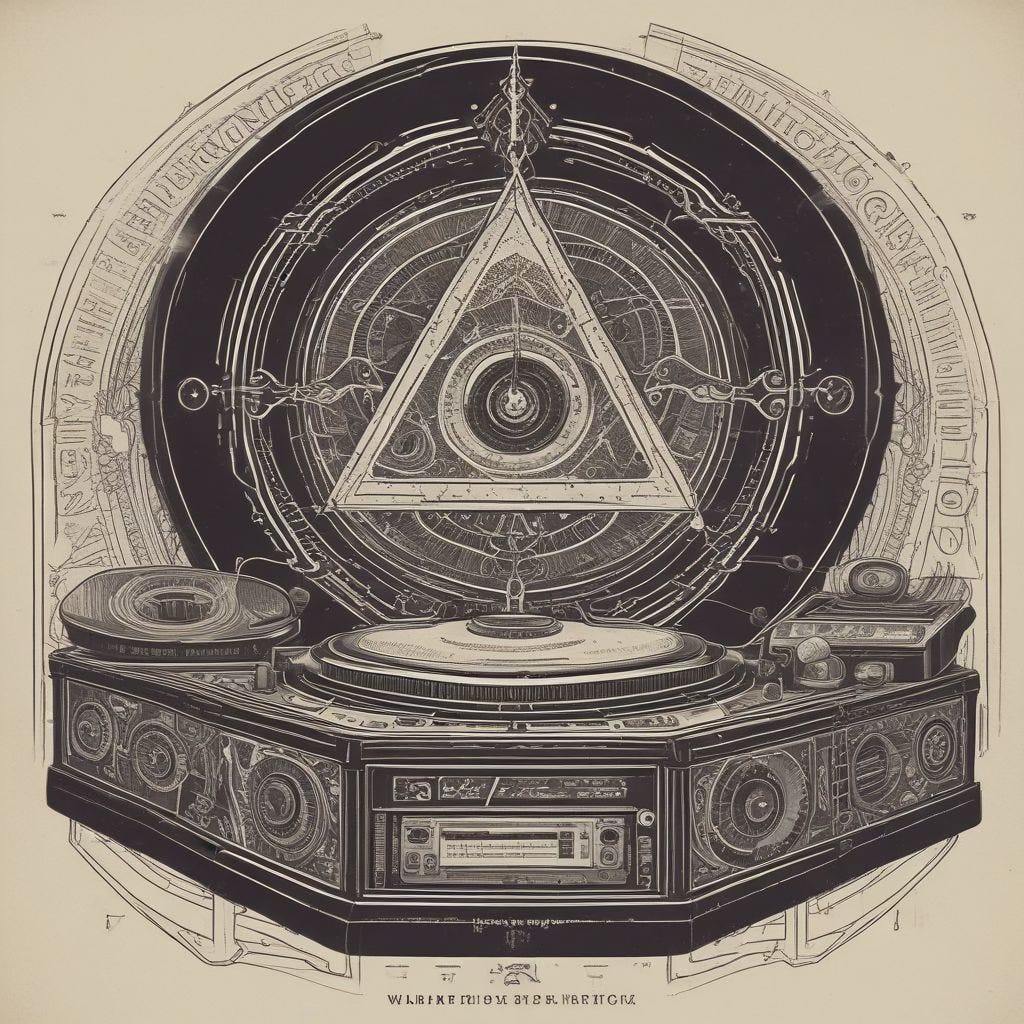
The Frequency War: 432Hz vs. 440Hz
A clandestine battle rages beneath hip-hop's surface—the conflict between natural and artificial tuning. Ancient instruments were calibrated to 432Hz, a frequency said to resonate with human biology and planetary vibrations. In 1939, Nazi Germany's Joseph Goebbels standardized 440Hz globally, which some researchers believe induces stress and compliance. Nearly all modern hip-hop adheres to 440Hz, but underground movements are reversing course.
Artists like Erykah Badu and Madlib have experimented with 432Hz tuning, while producers such as J Dilla intentionally used "off-grid" beats that disrupted mechanical perfection. The Lo-Fi hip-hop movement's vinyl crackle and analog warmth represent more than aesthetic choices—they're sonic resistance against the sterility of digital control systems.
Subliminals and Reverse Speech
The industry's alleged use of backmasking and subliminals remains hip-hop's most controversial frontier. Eminem's "My Name Is" contained reversed satanic messages according to Christian watchdogs, while Drake's "God's Plan" hid whispered phrases under the main vocal track. Whether psychological operations or creative Easter eggs, these techniques exploit the brain's tendency to find meaning in chaos—a phenomenon called apophenia.
Record labels have long been accused of embedding obedience patterns in music. The repetitive hooks of mumble rap, some argue, function as auditory conditioning, while trap's triplet flows may induce the same suggestible states used in MK-Ultra experiments. Conversely, artists like Kendrick Lamar weaponize these tools for consciousness expansion—the jazz-infused polyrhythms on To Pimp a Butterfly were deliberately designed to break habitual thought patterns.
The Underground Resistance
A vanguard of artists wages war against these manipulations. Noname's poetic jazz-rap operates at the intersection of Black liberation theology and sonic activism. J. Cole's Dreamville collective prioritizes live instrumentation to bypass digital frequency manipulation. The underground's embrace of Afrobeat rhythms and analog production creates what scholars term "acoustic sanctuary"—spaces where natural resonance can counteract industrialized mind control.
Producers like Knxwledge and The Alchemist craft beats with intentional imperfections—the slight drag of a snare, the breath between phrases—that humanize technology's cold precision. These "ghost notes," as Dilla called them, reintroduce the sacred stumble of organic creation, making the music breathe like a living entity rather than a programmed algorithm.
Conclusion: Decoding the Matrix of Sound
Hip-hop stands at the crossroads of ancient vibrational science and modern psychological warfare. Its power stems from an irreducible truth: sound shapes reality. The bass that rattles chest cavities, the rhymes that rewire neural pathways, and the symbols that lodge in collective memory all reveal how hip-hop—though born as entertainment and revolution —was reshaped into something far more potent, and at times sinister, by forces beyond its creators.
As the industry pushes sterile, algorithm-friendly rap, the underground resurrects music's primal function—as a tool for transcendence. The choice lies with listeners: will they remain passive consumers of frequency weapons, or active participants in hip-hop's original mission—the decolonization of the mind through rhythm? In an age of artificial intelligence and digital enslavement, the answer may determine more than musical preferences; it may dictate the future of human consciousness itself.
The beat, as always, goes on. But who truly dictates it?
This is a dope breakdown man. Sound and frequency really are all connected, and I feel like the vibe can be spread to your listeners based on what kind of frequencies you use in music as well, so good on you for making people aware of this.