
The Digital Plantation: How the Algorithm Rebuilt the Minstrel Show

The trajectories of Kai Cenat, IShowSpeed, and Druski are not merely success stories; they are a living case study in the evolution of 21st-century fame. They represent a paradigm shift in which the mechanisms of cultural production have been handed from traditional gatekeepers to engagement-driven algorithms. Their careers illuminate a new reality: fame is now manufactured through relentless content cycles, controversy is not a career-ender but a primary monetization strategy, and a generation is being systematically conditioned to equate chaos with authenticity.
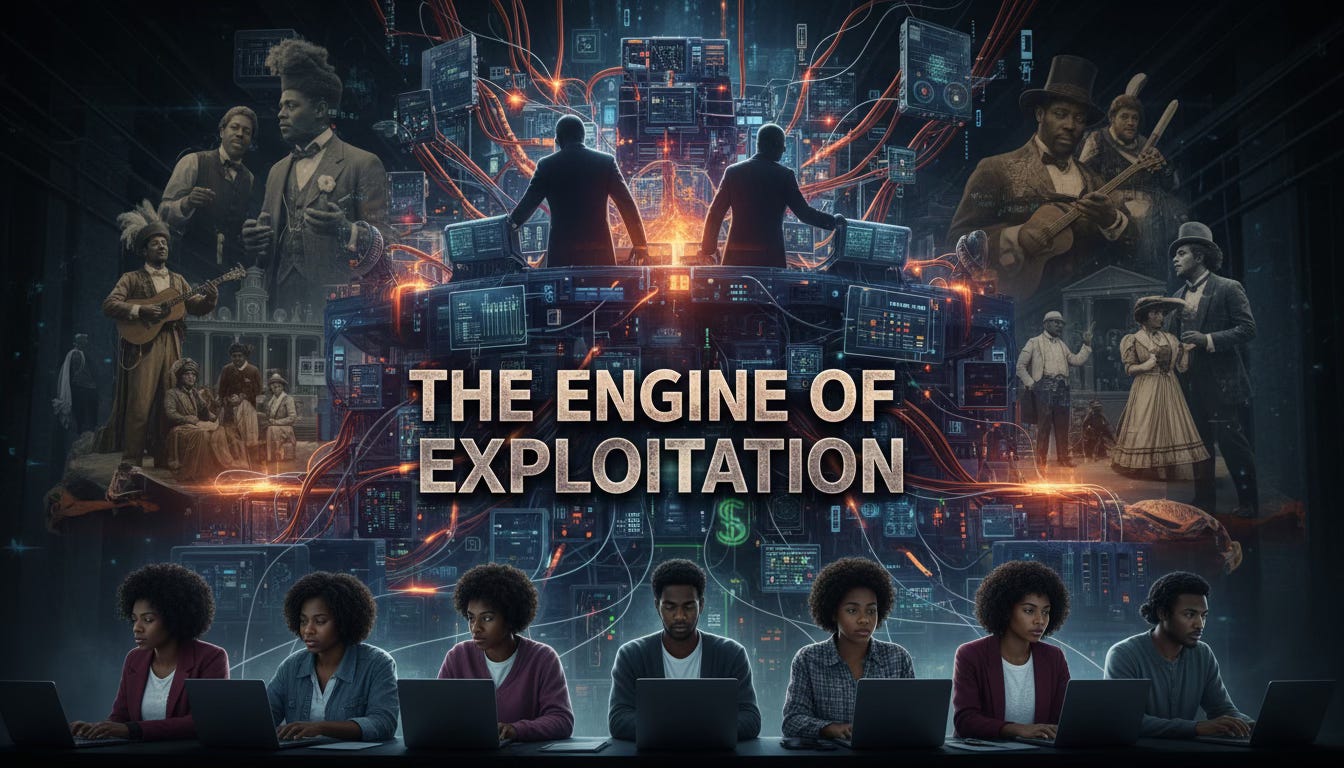
But to grasp this phenomenon, the critique must expand beyond the creators to the infrastructure that profits from them. This is not an accident of the internet; it is a feature of its carefully engineered economic engine.
The great poet and critic Amiri Baraka, in his seminal work Blues People, diagnosed this dynamic decades ago, observing that “whatever the slaves created was owned by the slave owners.” Today, the digital plantation overseers—the talent agencies, the management firms, the streaming platforms—operate on the same principle. The creators provide the raw, “authentic” energy the algorithms crave, but the power to greenlight, shape narratives, and cash out remains concentrated in a corporate structure that does not reflect them.
What we are witnessing is not just digital fame; it is a modern iteration of the minstrel show. Baraka understood that the “fundamental social philosophy characterizing American Capitalism... has always been shaped by white supremacy.” This system encourages young Black men to perform a stereotype of chaos and buffoonery for a global audience, generating immense cultural and financial value. It is, as Baraka might have recognized, a massacre of innuendo—a corruption of culture where the performer’s very being is repackaged as a commodity, and the primary beneficiaries remain far removed from the communities they profit from.
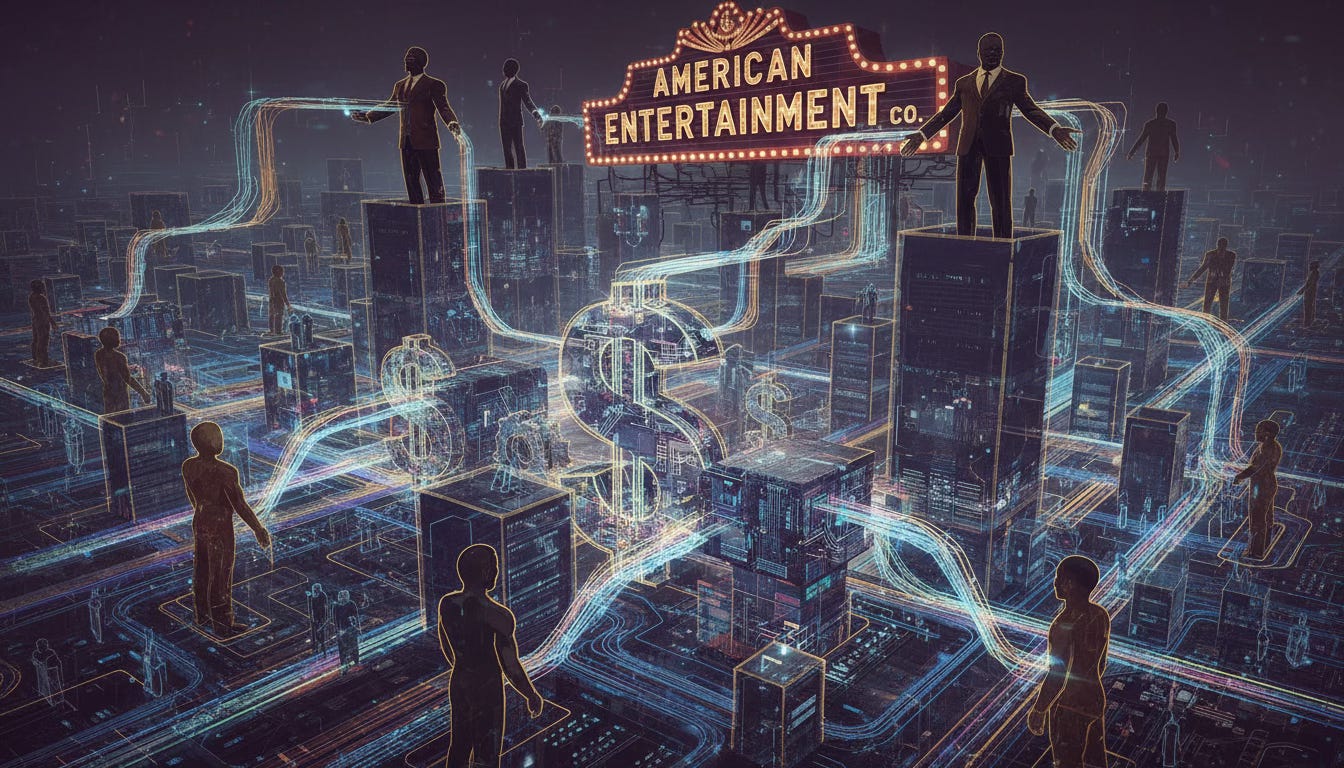
The Apparatus: UTA, Cooper Stein, and Peter Chernin
The involvement of major industry forces ensures this model is not a fleeting trend but a durable template. United Talent Agency (UTA) has made a deliberate strategic bet on this generation by signing Cenat and Druski, signaling that chaotic live streaming is bankable intellectual property worthy of A-list representation.
The day-to-day management falls to figures like Cooper Stein and Peter Chernin, whose roles represent the professionalization of the streaming economy. Stein’s job is not to prevent controversies—the Union Square riot, the hygiene rumors, the relationship scandals—but to manage them as assets. When rumors swirled about Cenat’s hygiene, prompted by fellow artists, Stein’s role was not to suppress the conversation but to ensure it remained within the ecosystem of engagement. The controversy generated millions of views and reinforced Cenat’s ubiquity. In the attention economy, being talked about for any reason is preferable to not being talked about at all. The humiliation of a young Black client is not a crisis to be averted, but a metric to be optimized. It is the digital equivalent of demanding the performer cakewalk faster.
Peter Chernin represents the “Hollywood-ization” of these creators. His involvement signals a long-term strategy of moving beyond streaming into legacy media. To firms like his, the “Cenat model” is a scalable asset class. They are betting that high-octane engagement, irrespective of social cost, will continue to be the most reliable path to dominance.
The unspoken reality is that the machine extracting value from Black cultural production is largely operated by non-Black hands. The creators provide the raw energy; their handlers provide the insulation and the exit strategy. When controversies erupt, the creators face the public scrutiny and reputational damage. The executives remain in the boardroom, ready to replicate the model with the next rising star. The mask has changed—it is no longer made of burnt cork, but of pixels and high engagement metrics—but the structure of the performance remains.
The Audience’s Agency
As long as algorithms reward provocation above all else—prioritizing watch time over substance—the machine will keep producing content designed to ignite rather than enlighten.
But to frame this as purely deterministic is to surrender our own agency. The audience—the collective “we” who click, watch, and share—retains the ultimate power: the power of demand. The same infrastructure that amplifies cruelty could just as easily elevate brilliance. The platforms that made Cenat a millionaire could just as powerfully elevate streamers who build genuine communities without enabling misogyny or inciting chaos.
The infrastructure is not neutral; it is designed to extract value from chaos. But we still have the power to choose whether we feed the beast it has created.
The Choice Before Us
This brings us to a moment of collective accountability. The audience must ask a difficult question: Are we truly powerless consumers, or are we active participants in a system we sustain with every click? Do we secretly crave the chaos we claim to condemn? When we share a clip of a streamer’s meltdown, are we criticizing it or contributing to its value?
If audiences continue to click and subscribe to the loudest, most disruptive voices, we will have chosen this future. We will have voted for a world where spectacle trumps substance, where Black creators are consumed for their chaos rather than celebrated for their craft, where the digital plantation overseers profit from a new form of minstrelsy.
The alternative is a more demanding path: to actively curate our digital diets, to elevate creators who offer genuine value, and to starve the chaos engine of the attention it requires. The choice, in the end, is not the algorithm’s, nor UTA’s, nor Chernin’s. It is ours. And it will determine not just who becomes famous, but what kind of culture we build together.
This is the same provocation 50 cent capitalizes on. It’s digital drug dealing and the consumers are the addicts. I think the masses will follow what the social engineering is. There will be creators who up lift but will have to jump through obstacles with platforms their subjective community policies.
👌👌👌